
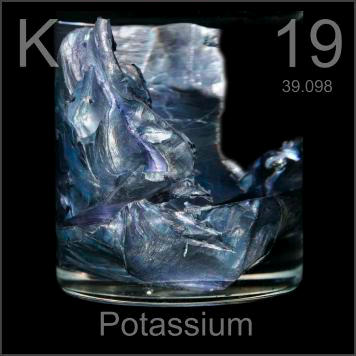
Marked with a letter K as its chemical symbol, Potassium is one of the most abundant metals on Earth. In nature, it occurs as ionic salt found dissolved in seawater, and as part of many minerals. It is also necessary for the function of plant and animal living cells. However, it does not exist in its pure elemental form because of its highly reactive nature.
Potash
Before the 18th century, people used potassium in the form of potash, a cleaning agent. Potash is a postassium compound made from wood ashes washed with water. Potash would dissolve in the water and it would be collected in large iron pots and evaporated. The white substance that remained was called potash.
The name potash came from the pots used in the process and the ash-like residue that is scraped from their bottom. It was also known as vegetable alkali (lye) because of the plants that gave the wood used for burning and producing the ash, and because of the property of the metal, which is alkali. This vegetable alkali was harsh type of chemical used for cleaning.
Potash is also rich in essential plant nutrients, which makes it a very effective plant fertilizer. After a long history of mining and manufacturing, potash was also used to make soap, glass, and dyes.
Potash was often misidentified with a similar cleaning agent called mineral alkali. It was obtained from rocks and was known as soda ash. They had the same qualities and they were used the same way. They only differed in their sources.
Discovery of Potassium
By the end of the 18th century, chemists realized that both the vegetable alkali and the mineral alkali have the same elements, which they had not identified before. They tried different methods of isolating these elements from the compounds.
In 1807, Humphry Davy, a British chemist, began working on separating the chemical elements. After making water solutions of potash and soda ash, he passed electric current through it. However, no result could be easily seen because the elements instantly reacted with the water.
Shortly after, Davy realized he had to exclude the water from his experiments. When he passed electric current through the solution of potash, tiny droplets of the metal emerged. He named this new metal potassium after potash.

This process made potassium the first metal isolated by electrolysis. Then a few days later, Davy was able to isolate sodium using the same method. This feat revealed that the wood ash was potassium carbonate and soda ash was sodium carbonate.
Producing Potassium
People used to cut down trees and burn them to produce wood ash for making potash. Now, potassium is produced only through electrolysis or through thermal methods that use potassium chloride. The source materials used for the process come from the abundant deposits of the metal found in ancient lakes and seabeds.
Potash, on the other hand, is mined from Saskatchewan in Canada, Germany and the three states in U.S. namely, California, New Mexico and Utah. Although the metal is non-toxic, it can be dangerous to anyone exposed to it. In its pure form, potassium is highly reactive.
Today, potassium is commonly used in making soaps, glass, fertilizers, medicines, explosives, and fireworks. It is also an essential nutrient for the human body.
